
Searching Calhoun County Civil Dockets
MiCOURT Case Search is the free statewide window into public Register of Actions entries. Pick the court first. C37 is the direct route to the 37th Circuit Court. D10 goes straight to the 10th District Court. P13 leads to Calhoun County Probate Court. The interface accepts a name or a case number. Court selection still matters because the three courts keep their own records.
For the last-name or business field, type at least two characters. First and middle names, birth year, case category, status, and filed-date filters are all optional. Apply a filter only if you are sure. Wildcards are not allowed in name or case-number fields. An exact case or petition number remains the strongest key for a docket search.
- Identify the likely court, then open MiCOURT’s C37, D10, or P13 route.
- Choose Name Search for a party or business, or Case Number Search for an exact court-issued number.
- Use Civil, Domestic, or Probate category choices only when they match the subject and court.
- Open the likely result and read the caption, roles, filings, motions, orders, settings, and status in time order.
- Ask the court custodian for an unavailable document or certified judgment.
Calhoun Civil Dockets: C37 or D10
Which court holds the case depends on the claim. Calhoun's Circuit Court handles general civil claims of $25,000 or more. County-wide appeals sit there too. So do domestic relations, family matters, and other Circuit jurisdiction. The 10th District Court keeps the smaller stuff. That includes limited-jurisdiction civil, small claims, civil infractions, and ordinance records. Estates, trusts, guardianships, conservatorships, and specified mental-health matters sit in P13 instead of the ordinary Circuit or District civil register.
The $25,000 figure is the Circuit Court's published general-civil marker. Where does a borderline civil filing belong? The District Court's own office confirms it. City administration may handle an ordinance matter first. Once it reaches court, though, it follows the D10 docket route. The 37th Circuit Court page posts official Circuit resources and its own case-search access.
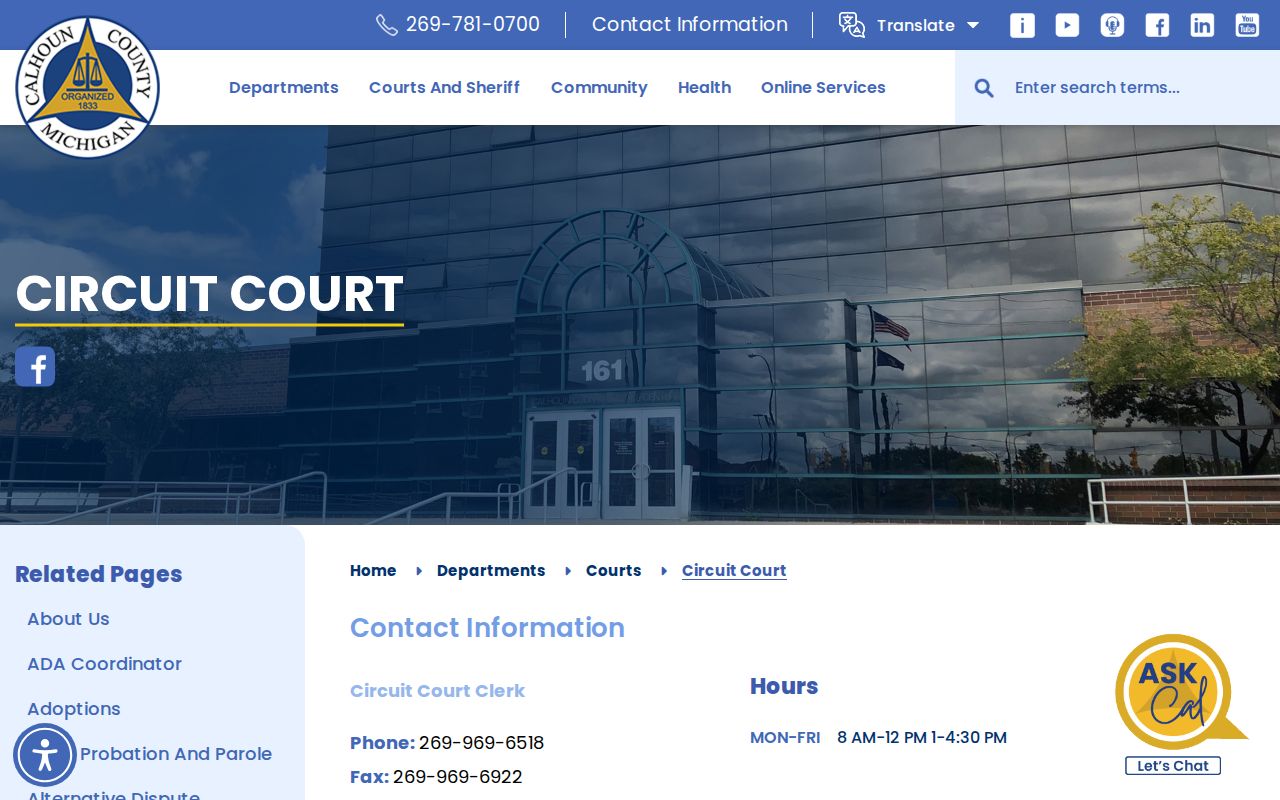
The courts share one Justice Center. That makes visits easy, not records interchangeable. The court and its clerk still decide which Calhoun civil docket controls the file. The 10th District Court's official page links its case search, calendar, payment, and court resources.
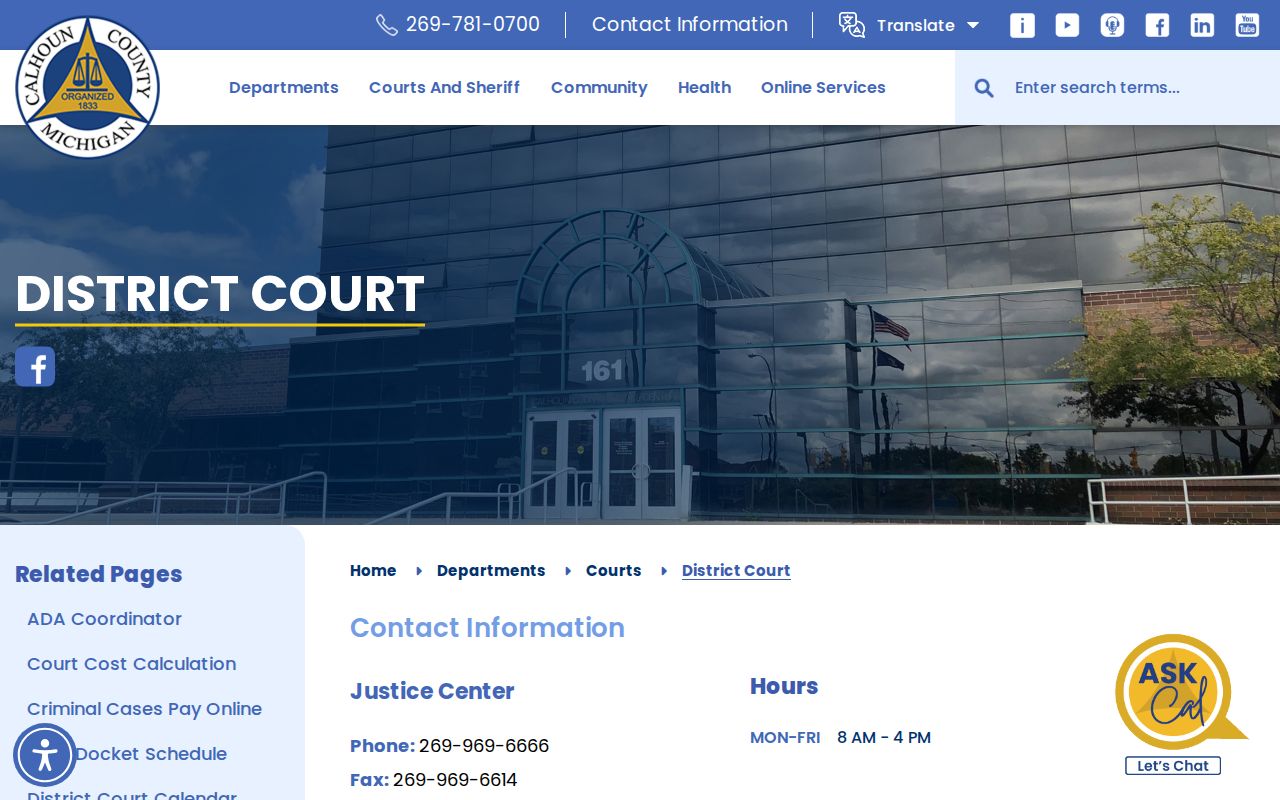
Those separate District tools explain the pattern. A limited civil or small-claims lookup belongs in D10, not a general county-office search.
Inside a Calhoun County Civil Docket
A civil Register of Actions opens with a case header. Expect the court, filing date, status, assigned judge, caption, and party roles. The entries run in order. A complaint or petition may come first. A summons, return of service, answer, counterclaim, motion, response, hearing, order, judgment, costs, appeal, or reopening event can follow. The public display may hide documents or mask protected information. So a docket entry marks a step in the history. It is not a stand-in for the filing itself.
| Caption and roles | Shows plaintiff or petitioner and defendant or respondent roles where public, plus other roles when relevant. |
|---|---|
| Claim classification | May identify civil case type, cause or category, relief field, and jury-demand indicator. |
| Service entries | Includes summons, proof or return of service, notices, and returned-mail information when displayed. |
| Motions and orders | A motion records a request. The court’s decision is found in the order or later disposition entry. |
| Closure history | Look for default, settlement, dismissal, judgment, appeal, remand, or reopening events rather than status alone. |
A status like Open, Closed, Disposed, ADR, Mediation, or Deferred is a filter label. Treat it as a clue, not the full result.
Calhoun Civil Docket Party Roles
Every name on a civil result carries a role. A plaintiff starts a complaint. A defendant answers it. A petitioner asks for an order or other relief, and a respondent replies to that petition. The docket may also list an intervenor, a third-party role, attorney fields, or service details. Read the role before concluding anything, since one name can appear in several civil cases.
- Caption
- The court’s displayed case title and party roles.
- Service
- The process showing notice or a court paper was delivered or attempted.
- ADR
- Alternative dispute resolution, a status or process category that does not itself state the final result.
- Summary disposition
- A civil motion-based resolution without a full trial.
Calhoun's official pages do not publish a complete docket-code dictionary. Read the event description and the resulting order instead. A short code does not mean the same thing in every case.
Civil Case Types on the Docket
There is no single Calhoun civil case category. Circuit records can include major civil claims, domestic relations, family matters, and county-wide appeals. District records cover limited civil claims. Small claims, civil infractions, and ordinance matters sit there too. Probate proceedings run on their own P13 route. Search the register that matches the subject matter, not the person's city of residence.
- General civil claims in Circuit Court when the published $25,000 or more marker applies.
- District civil and small-claims cases maintained by the 10th District Court Clerk.
- Domestic and family matters within Circuit Court jurisdiction, subject to access limits.
- Estate, trust, guardianship, conservatorship, and probate mental-health matters under P13.
- Ordinance matters that enter the District Court docket after local administration.
Some family and domestic records carry different public-access rules. Ask the specific court clerk about lawful access rather than treating a thin online result as the whole file.
Calhoun Civil Docket: Motion or Order
A motion entry in a Calhoun civil docket is easy to misread. People assume the court granted it. In fact, the entry usually just marks a filing, and sometimes a hearing date. Watch what comes after it. A response, an order, a judgment, a settlement, or a dismissal tells you how the request ended. Service and appearance entries deserve the same care. They show whether each party got notice or took part before you draw conclusions.
Later events can stay in the chronological history too. An appeal, a remand, a reassignment, a consolidation, or a reopening may all appear there. An appeal is one example. The trial-court Register of Actions can list it as an event even though a separate file sits in the Michigan Court of Appeals. For status questions, look late. The newest order usually explains more than any single earlier entry in the court docket.
Do you already know the case you need? The Calhoun County Case Lookup page walks through the name- and number-search process for finding the Register of Actions before you request a document.
Civil Docket Settings and Hearings
A Calhoun County civil docket can show a motion hearing or status conference. A settlement event or a trial can appear too. It is just a schedule entry. Seeing it there proves nothing about what happened in court or how the case resolved. Do you already know the case? Start with the Register of Actions, the strongest public source for any setting tied to it. County daily-docket pages and MiCOURT CourtDisplay add date-driven schedule details where they exist.
Read a row as a whole. The court, time, room, case number, and judicial officer all matter together. A CourtDisplay row can give you the party name, time, room, and case number in one line. One catch exists. The generic public view does not always show what kind of setting it is. A reset, continuance, or later order means the newest entered setting is probably the live one. Confirm any imminent hearing with the court before you rely on it.
Calhoun Civil Docket Filing Systems
MiFile and MiCOURT do different jobs for Calhoun County civil cases. MiCOURT is the public case-history reader. MiFile is listed as TrueFiling in the state directory. It is an electronic filing layer, open only to courts marked as available. The official directory shows Calhoun's 10th District Court and Probate Court on that list. The 37th Circuit Court page states that Circuit Court is not a MiFile court at this time. Keep the two straight. A filing workspace is one thing, and a public Register of Actions search is another. The MiFile available-courts directory shows which Calhoun courts currently accept electronic filing.
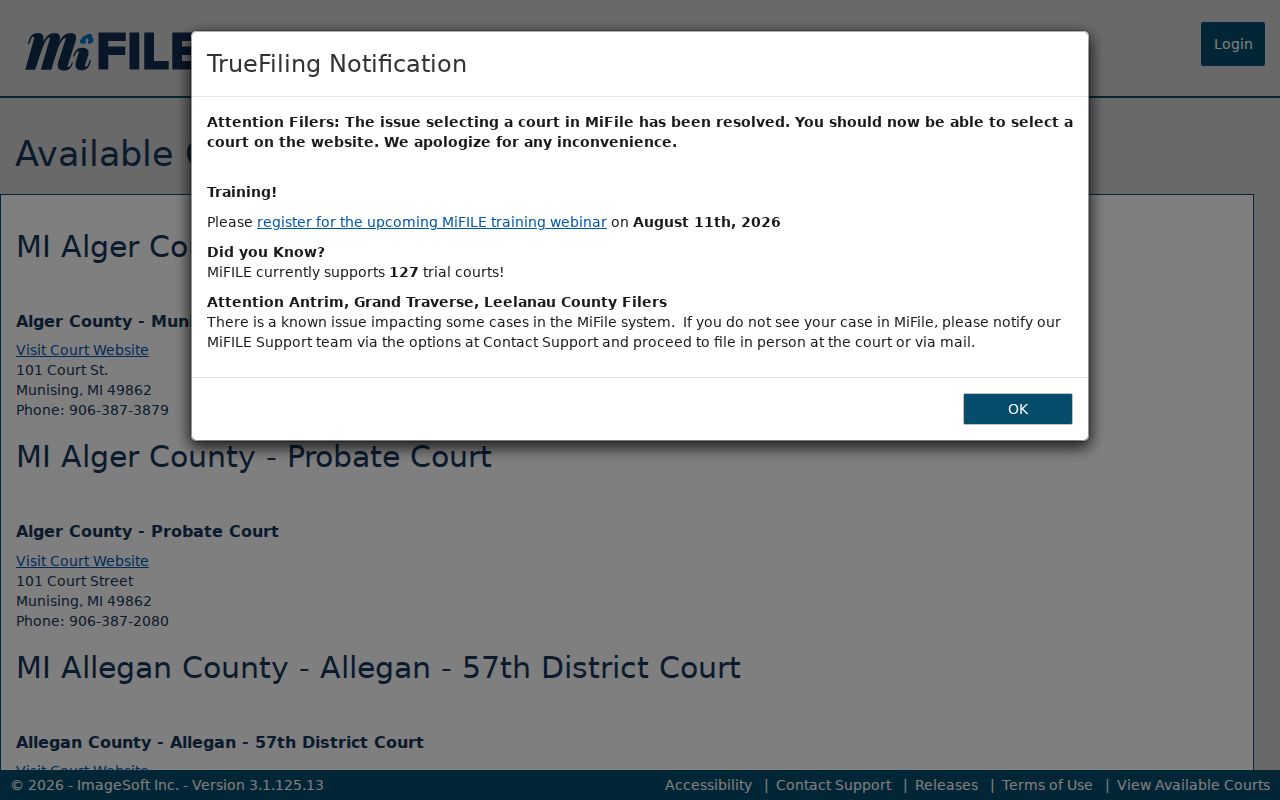
That directory answers one question only, whether a court takes electronic filings, not whether its docket history is open to public searching. The MiFile entry point is the official filing-system start for eligible courts.
One more wrinkle. A document can be filed and logged as a docket event even though its full image stays out of the free public search.
Calhoun Civil Judgment Requests
A judgment event in an online docket tells you where to look. It does not say what a certified judgment says. Before calling the clerk, pin down the court, case number, document title, and event date. For Circuit records, check the clerk's published fee information. Certification of one document runs $10 plus $1 per certified page. Say plainly whether you need a plain copy or a certified one.
Send the request to the right office. The Circuit Clerk holds Circuit civil files; the District Clerk keeps District Court records. County FOIA is not the route for court records here. Calhoun's FOIA page says courts are not public bodies. They sit outside that county process. A sealed, redacted, or otherwise restricted document may need a different lawful access path.
Note: Ask the court to confirm current fees and delivery methods. Confirm the exact document too. Do this before you send payment or a broad file request.
Civil Docket Access Rules
Michigan opens its court records under rules that shield nonpublic material and personal identifiers. A Calhoun County civil docket may show the public history of a case. It may hold back an image. It may show redacted data instead. Protected domestic-violence information, sealed documents, and restricted case types can all shrink what appears. A no-result might mean you picked the wrong court or filter. It might also mean a lawful public-access limit.
For a public document, ask the clerk who keeps the case. For a sealed or restricted matter, ask what access route the rule or court order allows. Do not use the county's NextRequest FOIA portal for these. That portal handles county public-body records, not trial-court files.
Michigan court-record rules:
MCR 8.119 governs trial-court record duties and access.
MCR 1.109 addresses filing and protected personal identifiers.
Calhoun County’s FOIA page directs court-record requests to the court, not county FOIA.