
Searching Calhoun County Criminal Dockets
MiCOURT Case Search is where Michigan residents begin a Calhoun County criminal docket lookup. Pick the right Calhoun court before trusting a name match. C37 is the direct route for the 37th Circuit Court. D10 covers the 10th District Court. A felony may leave footprints in both. Early District Court proceedings can later shift to Circuit Court. MiCOURT labels the chronological history a Register of Actions. Locally, people just say docket for the daily calendar too.
Bring the exact case number if you have it. With nothing but a name, use a last or business name. Type at least two characters. First and middle names, a four-digit birth year, case category, status, and date ranges can narrow a common name. A needless filter may bury the result, though. Wildcards are banned. What the public sees is informational only. So ask the clerk for a certified order or any document image that is not online.
- Match the charge level to C37 or D10, then open the appropriate MiCOURT route.
- Select Name Search or Case Number Search and enter the court-supplied number exactly when it is known.
- Limit results only with a known criminal category, status, or date; remove filters after a no-result.
- Open the matching case and read the header, charge entries, settings, and chronological history in order.
- Contact the clerk that keeps the case for a missing document, an older record, or a certified copy.
Calhoun Criminal Dockets: C37 or D10
There is no single criminal register for Calhoun County. The 37th Circuit Court Clerk keeps felonies under C37. Those are charges carrying more than one year. The 10th District Court Clerk holds D10: misdemeanors, traffic misdemeanors, civil infractions, ordinance prosecutions, and matters like OWI-type or suspended-license charges. That court code keeps a Calhoun criminal docket search pointed at the right clerk.
A felony's early probable-cause or preliminary work may sit in District Court. A bind-over sends it upstairs. If an entry says bind-over, transfer, remand, or reassignment, pull both histories. Earlier events stay in the case history even after the active proceeding changes courts.
The 10th District Court's official page connects to its case search. It also links its calendar, payment options, and MiFile details. It confirms locally that District Court and Circuit Court serve separate functions.
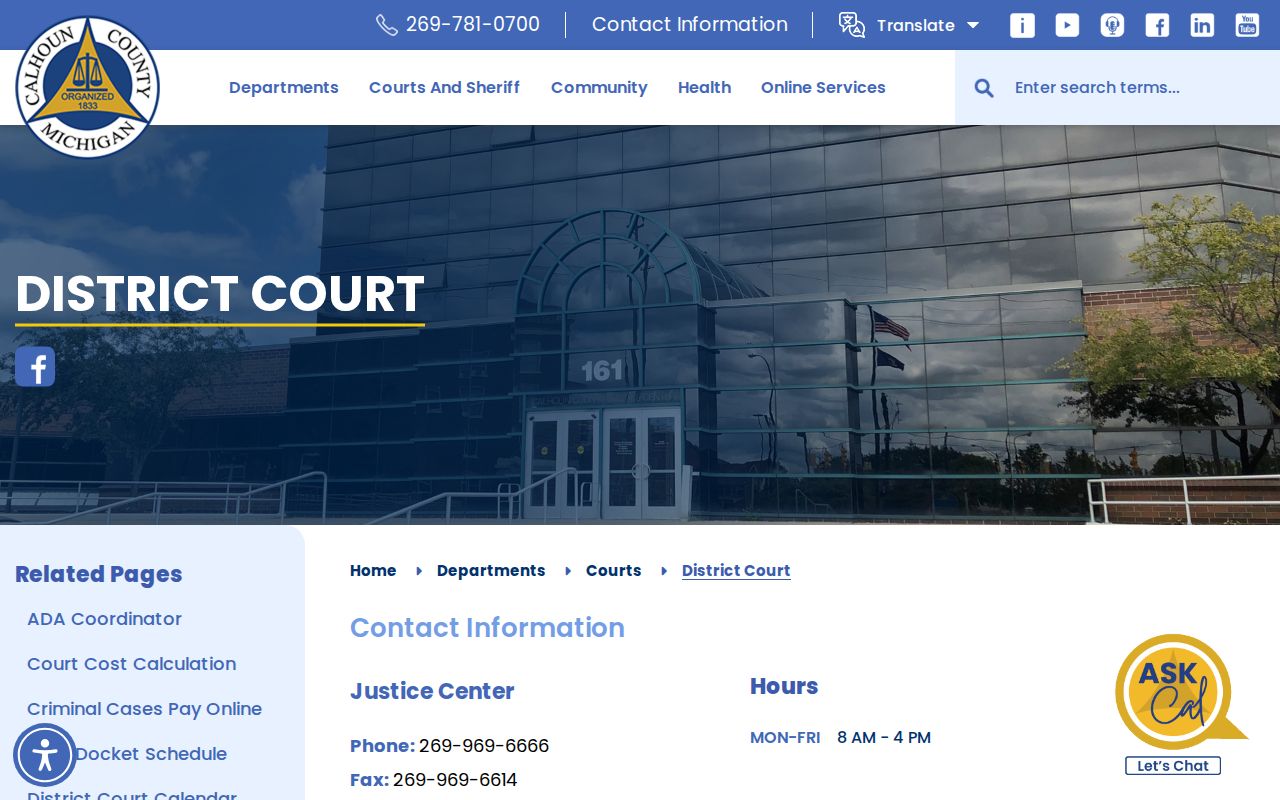
For a criminal docket route, that court-level split matters far more than the shared Justice Center address.
Inside a Calhoun County Criminal Docket
A criminal Register of Actions opens with a case header. There you may see the court, case number or case ID, category, filing date, status, judicial officer, and sometimes a location. The detail history below it can list participants, charge counts, offense-level text, complaint or warrant events, bond events, plea activity, hearings, disposition, sentence, and financial entries the portal makes public. Treat each field as a record of one case event. None of it replaces the order itself.
| Case number | Use the exact identifier from the court notice. MiCOURT illustrations include 1818003SC and 000001073; they are examples, not a complete Calhoun code key. |
|---|---|
| Charge and count | Shows an alleged offense, count, and related classification where public. A charge is not a conviction. |
| Settings | May show arraignment, preliminary examination, pretrial, motion, trial, plea, sentencing, or review events with date and time. |
| Disposition | Look for a plea, verdict, dismissal, judgment, deferred result, or other final event before describing an outcome. |
| Financials | Portal amounts can be limited. The court or payment custodian provides an official balance or receipt. |
Note: A future hearing row records a setting only. It does not prove the hearing happened or that a judge decided anything.
Calhoun Criminal Docket Charge Entries
Calhoun criminal docket entries keep an allegation separate from a result. Begin with the count and charge text. Then follow the events through a plea or trial to the disposition or judgment. A scheduled hearing is not the order that follows it either. Keeping those pieces apart stops a searcher from mistaking a charge entry, bond event, or status filter for the case's final outcome.
- Bound over
- A felony proceeding moved from District Court to Circuit Court after the preliminary stage.
- Deferred
- An action or outcome postponed under a court program or order; it is not automatically a dismissal.
- Nolle prosequi
- A prosecution discontinued; the actual order supplies the case-specific effect.
- Remanded
- A matter returned from an appellate or higher court, often followed by new trial-court events.
Note: Official Calhoun pages publish no complete local abbreviation key. Trust plain-language event text over guesswork about short labels like MOT, ORD, CONT, or DISP.
How a Criminal Case Moves
Most Calhoun criminal cases travel a familiar path. A complaint, warrant, or citation comes first. Then arraignment and pretrial work. Then a plea or trial, disposition, and sentencing. Felonies may add a probable-cause stage and a District-to-Circuit bind-over. The Register of Actions runs in chronological order. So the newest order or event usually carries more current context than an old calendar line.
Docket flow: Filing or charge › Arraignment › Pretrial or preliminary stage › Plea or trial › Disposition › Sentencing or review.
When a date looks near, set the case history beside the county's daily court schedule and confirm with the court. A reset or continuance only moves the timing. It never resolves the charge by itself.
Calhoun Felony Bind-Over Dockets
The District and Circuit split creates a local quirk. One felony can carry a D10 history for early proceedings and a C37 history after bind-over. Search the court named in the notice first. Then check the other when the event sequence shows a transfer. Sharing a building does not merge the two dockets.
The 37th Circuit Court page offers the Circuit Court's official resources and case-search path. It also describes a text or email reminder option for Circuit events. Signing up takes the case number, felony status, and an interest category. You also need verified contact information and confirmation.
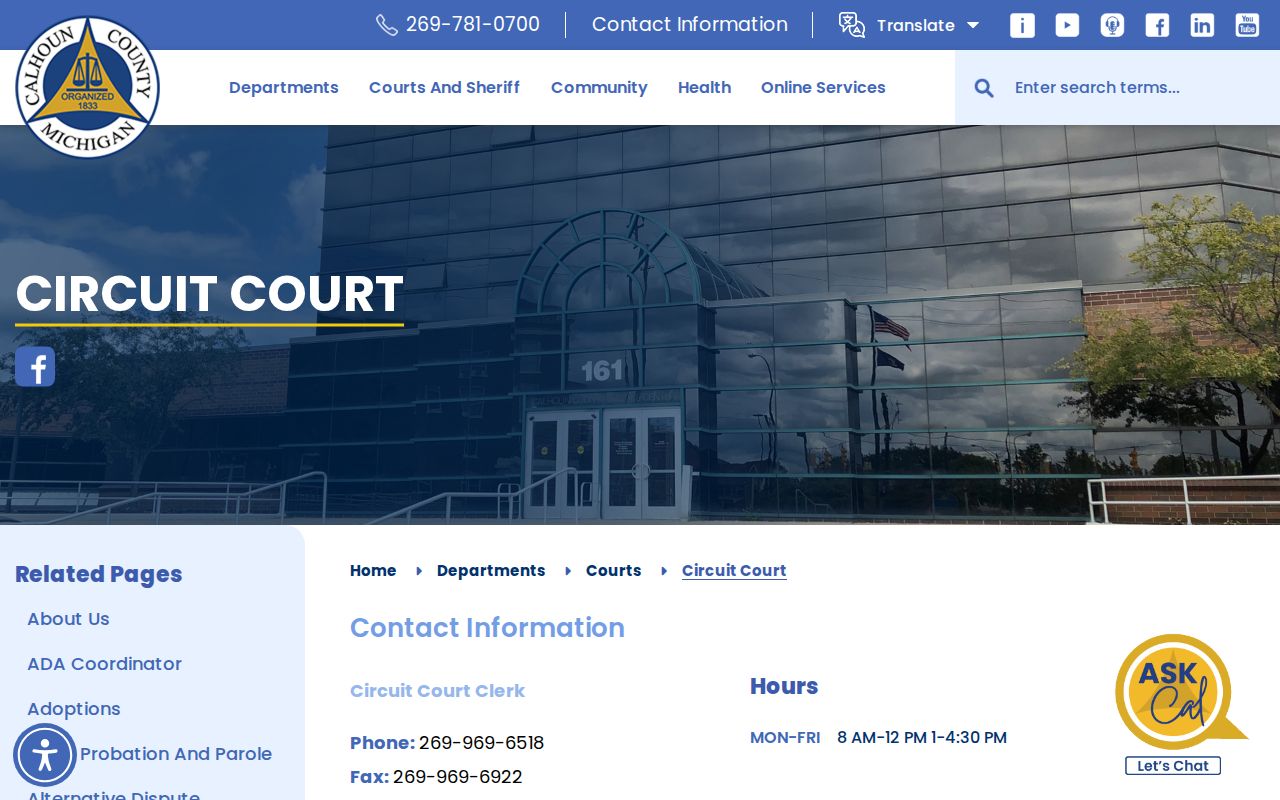
Note: The County's reminder system sends one reminder per event, two or three business days ahead. It supplements the register and court confirmation rather than replacing them.
Courts That Hold Criminal Dockets
Two clerk offices split the Calhoun County criminal docket. The 37th Circuit Court Clerk's Office keeps the Circuit criminal register, which covers felony records. The 10th District Court Clerk holds the District criminal docket along with traffic, civil-infraction, and ordinance cases. Both sit inside the Calhoun County Justice Center. They are still separate courts with separate clerks. And the county Clerk and Register of Deeds is not the usual keeper of these trial-court registers.
Need a case history fast? The public MiCOURT reader is the online route. For filed documents, certified copies, transcripts, or anything the display leaves out, go to the clerk maintaining the case. The Circuit Court Clerk's official page lays out the Circuit record-request route, with email and in-person options for 1984-present matters.
Calhoun Treatment-Court Docket Events
Calhoun's treatment courts are programs layered on top of a case. They are not stand-alone criminal-search databases. The 37th Circuit Drug Treatment Court handles felony alcohol- and drug-related matters through phases, treatment, testing, support, case management, education, and review sessions. The 10th District Court runs its own set. It offers Domestic Violence Intervention, Mental Health Treatment, Sobriety, and Veterans Treatment Court.
So where do you look? Search the underlying C37 or D10 criminal docket for public case events. Treatment participation, review hearings, compliance events, and sanctions may show in the history. Sensitive treatment material can be limited, though. Who may lawfully inspect or copy? The program's own access rules and the clerk decide. The county's Drug Treatment Court page describes the program's eligibility and its phased structure.
One distinction matters here: a specialty program does not create a separate public case-number system.
Sealed Dockets and Public Access
A Calhoun criminal docket has real public-access limits. MiCOURT's public notices exclude or suppress many sensitive matters, including juvenile and child-protective proceedings. There is also a seven-year criminal display notice. So an older matter may need a direct request. That can be true even when the case is not sealed. A missing result is not proof that a case never existed.
Michigan law keeps juvenile records nonpublic as a rule. The Circuit Clerk asks for identification when juvenile documents come up. Sealed records answer to a court order. No clerk can override it just because you ask. A redacted public document is different from a fully sealed case, too. Know which barrier you are facing before you request copies.
Michigan access rules:
MCR 8.119 requires trial-court record keeping and public access subject to restrictions and redaction.
MCR 1.109 addresses filing, electronic records, and protected personal identifiers.
MCL 712A.28 places important limits on public access to juvenile records.
Calhoun Older Criminal Docket Searches
An older Circuit criminal matter may not show in full online. For Circuit records from 1984 forward, the clerk offers a search and purchase path. Use email or go in person. Include the case number and known party details in your request. Records from 1948 through 1983 sit on microfilm. Those need a nonrefundable name lookup. For pre-1948 material, the clerk points researchers elsewhere. That is Western Michigan University's Zhang Legacy Collections Center.
The seven-year notice on the online criminal display is separate from these archival eras. Try the right C37 or D10 docket search with fewer filters first. Then ask the court that keeps the record. It can explain the lawful path for an older or incomplete result. Do not send a court-file request through the county FOIA portal. Calhoun's FOIA page says it plainly. Courts are not county public bodies for that process.
Note: a clerk can explain record process. Legal advice is off limits. Court staff cannot advise on a charge or a case strategy.